Free fall protection plan template and generator
Fall protection plan for your job site, in English and Spanish
Describe the work at height and AI writes a site-specific plan from OSHA's fall protection rules: the hazards and how each is protected, anchors, rescue and training, with the Spanish side by side. Or download the blank template and fill it in.
- ✓ Written from 29 CFR 1926 Subpart M, with the sections listed
- ✓ Ends with the crew's training record, signed on paper or phones
- ✓ No sign-up to try; a free account saves the PDF
Free fall protection plan template
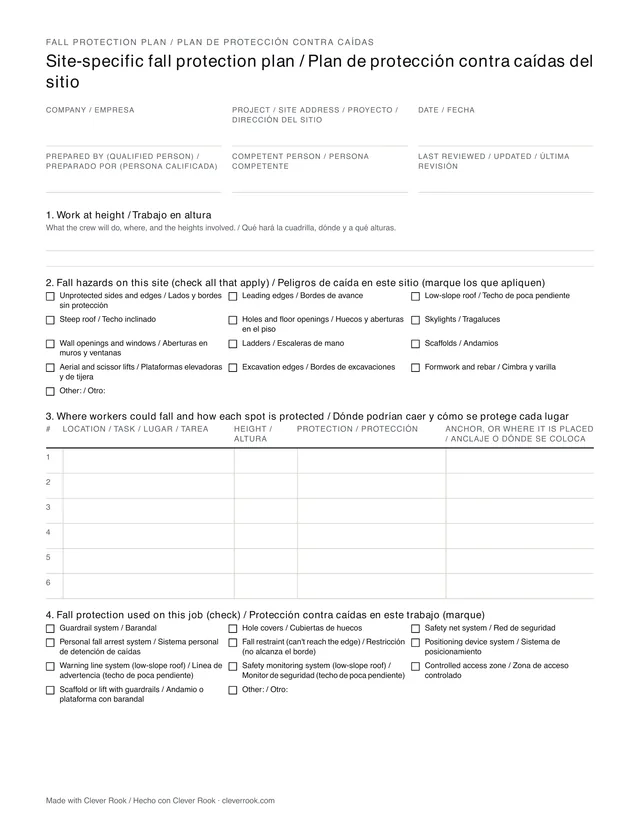
A blank site-specific fall protection plan on two letter pages, with English and Spanish on the same form: who prepared it and who the competent person is, a checklist of fall hazards, a table of where workers could fall and how each spot is protected, the protection methods used, equipment and anchors, set-up and take-down, materials, rescue, the alternative plan for when conventional protection can't be used, and changes. The last page is the crew's training record.
Edit it in Word: English + Español · English · Español
What a fall protection plan includes
A fall protection plan is the written plan, kept on the job site, of where workers could fall on that job and how the company protects them. A good one is specific: it names the roof edges, openings and ladders on this site rather than repeating a company policy. Most plans cover these parts:
1.Fall hazards
Every place on the job where someone could fall: roof edges, leading edges, holes, skylights, ladders, scaffolds, lifts.
2.Protection for each spot
Guardrails, covers, nets, personal fall arrest, warning lines: which one, where it attaches or stands, who sets it up.
3.Equipment and anchors
What the crew uses, where the anchors go, and inspection before each use.
4.Set-up and take-down
How the systems are put up, maintained, inspected and taken down as the work moves.
5.Materials and people below
Storing and securing tools and materials at height, and keeping people out from under the work.
6.Rescue
How a worker who falls will actually be reached and brought down, with the equipment and people on site.
7.Training
Who is trained on the plan, by whom and when: the written record OSHA asks for.
8.Changes
Keeping the plan on site and current, and what happens after a fall or a near miss.
Does OSHA require a written fall protection plan?
Not for every job. Federal OSHA requires the protection itself: workers on construction surfaces with an unprotected side or edge 6 feet or more above a lower level must be protected by guardrails, safety nets or personal fall arrest (29 CFR 1926.501), and every worker who might be exposed to fall hazards must be trained, with a written certification record of that training (29 CFR 1926.503).
A written plan becomes a requirement in these cases:
- The alternative plan in 29 CFR 1926.502(k). In leading edge work, precast concrete erection or residential construction, an employer that can show conventional fall protection is infeasible or creates a greater hazard may use a written, site-specific plan instead (more below).
- Washington State. Employers must develop and implement a written fall protection work plan covering each area where fall hazards of 10 feet or more exist, available on the job site for inspection (WAC 296-880-10020, on L&I's fall protection work plan form).
- Your contract. General contractors, owners and insurers often ask each subcontractor for a site-specific fall protection plan before work starts, alongside a site-specific safety plan.
Even where no rule requires one, a written plan is how you show that the protection, the rescue and the training were thought through before anyone went up.
At what height is fall protection required?
| Where | Height | Rule |
|---|---|---|
| Construction: unprotected sides, edges, roofs, holes | 6 feet | 29 CFR 1926.501(b) |
| Construction: scaffolds | 10 feet | 29 CFR 1926.451(g)(1) |
| General industry (not construction) | 4 feet | 29 CFR 1910.28(b)(1)(i) |
| Washington State: written fall protection work plan | 10 feet | WAC 296-880-10020 |
Some work has its own rules, such as ladders, aerial lifts, steel erection and excavation edges, so check the section for the equipment you use. The generator adds the ladder, scaffold or lift sections when your work mentions them.
The fall protection plan in 29 CFR 1926.502(k)
When people say OSHA "allows a fall protection plan", they mean this option. It is available only to employees doing leading edge work, precast concrete erection or residential construction, and only where the employer can demonstrate that guardrails, safety nets and personal fall arrest are infeasible or create a greater hazard. The standard presumes they are feasible, and OSHA's residential construction directive (STD 03-11-002) enforces conventional fall protection in residential work. The plan must:
- be prepared by a qualified person, specifically for the site, and kept up to date, with changes approved by a qualified person;
- be kept at the job site and carried out under the supervision of a competent person;
- explain why conventional fall protection is infeasible or would create a greater hazard;
- discuss the other measures that reduce the hazard, such as scaffolds, ladders or vehicle-mounted platforms;
- identify each location where conventional protection can't be used, as a controlled access zone;
- use a safety monitoring system where no other measure is in place;
- name the employees designated to work in those zones, and no one else may enter;
- be reviewed after a fall or a near miss, with changes made to prevent a repeat.
OSHA publishes a sample residential fall protection plan. In the generator, fill in "Where guardrails, nets or harnesses can't be used, and why" only when this applies; the plan then adds the section with your reasons, the controlled access zones and the safety monitor. It never invents the reasons.
The rescue plan
The employer must provide for prompt rescue of a worker who falls, or make sure workers can rescue themselves (29 CFR 1926.502(d)(20)). Calling 911 isn't a rescue plan on its own: responders may not reach a worker hanging from a roof edge quickly. A useful rescue section says how a fallen worker would be reached on this job (a ladder, a lift, a rescue kit), where that equipment is, who is trained to use it, and what the crew does while help comes. The template has space for each, and the generator writes it for your work and equipment.
How to use the fall protection plan generator
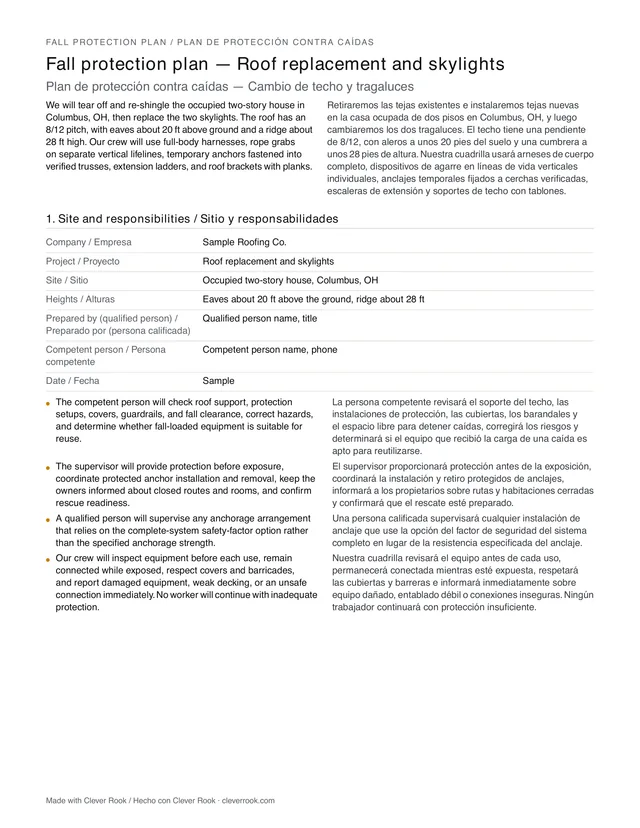
- Describe the work at height the way the job does: "Tear off and re-shingle a two-story house, then replace two skylights" beats "roofing".
- Add the heights and conditions: eave and ridge heights, roof pitch, openings, what's below the work.
- Read the plan in English and Spanish, then save it to a free account to add the names, the hospital and the rescue crew, print it, and have the crew sign that they were trained on it.
In your account the form also takes the fall hazard checklist, the equipment and anchors, the qualified and competent persons, and the workers designated for controlled access zones. Names and phone numbers are printed as you type them and never sent to the AI.
How it stays accurate
Every plan is written from the full text of OSHA's fall protection rules, 1926.501 to 1926.503, plus the ladder, scaffold or aerial lift sections your work calls for, taken from eCFR. The plan may only state a height, strength or distance that appears in that text or in what you entered, and it lists the sections it relies on. It is still a draft for your qualified or competent person to check against the site.
Training record and crew sign-off
Subpart M requires a written certification record for fall protection training: the name of each employee trained, the date of the training and the signature of the person who trained them or of the employer (29 CFR 1926.503(b)). Every plan ends with a training record laid out that way. Workers can sign it on paper or scan its QR code and sign on their phones after reading the plan in English or Spanish, and the record stays in your account with the plan.
For the weekly reminders, use the fall protection toolbox talk, the personal fall arrest talk and the ladder safety talk, or see the roofing JHA example.
Questions
Is the fall protection plan generator free?
Yes. Write a plan on this page without an account, up to 3 a day. A free account adds the printable PDF with the training record, phone sign-off and a saved copy, for 3 documents a month. The blank template is free to download in PDF and Word.
Who should prepare a fall protection plan?
Someone who knows the site and the systems the crew will use. For the alternative plan in 29 CFR 1926.502(k), the rule is specific: a qualified person prepares it for the site, a qualified person approves any changes, and a competent person supervises it on the job.
How often should a fall protection plan be updated?
Whenever the work, the site or the equipment changes. A 1926.502(k) plan must be kept up to date with a copy on site, and after a fall or a serious incident such as a near miss the employer must investigate and change the plan, practices or training where needed. Many contractors also review the plan with the crew at the start of each job.
What are the types of fall protection?
OSHA calls guardrail systems, safety net systems and personal fall arrest systems conventional fall protection. Subpart M also covers hole covers, positioning device systems, warning line systems and safety monitoring (on low-slope roofs), controlled access zones, and protection from falling objects, each with its own limits.
What is OSHA's 4-foot rule?
In general industry (warehouses, plants, shops), workers on a surface with an unprotected side or edge 4 feet or more above a lower level must be protected from falling (29 CFR 1910.28(b)(1)). Construction work uses 6 feet (29 CFR 1926.501(b)(1)), and scaffolds 10 feet.
Does a fall protection plan replace guardrails or harnesses?
No. A plan describes the protection; it isn't protection itself. Only the 1926.502(k) plan lets an employer use other measures instead of conventional fall protection, and only for leading edge work, precast concrete erection or residential construction where the employer can show conventional protection is infeasible or creates a greater hazard.
Is the Spanish a machine translation?
It's written together with the English as a faithful translation in the plain Spanish used on US job sites, side by side so a foreman can go through it with a mixed crew. Have someone on your team read both before the plan is used.
Sources: 29 CFR 1926.501; 29 CFR 1926.502; 29 CFR 1926.503; 29 CFR 1926.451; 29 CFR 1910.28; OSHA directive STD 03-11-002; Washington L&I form F417-272-000.
Write the plan for your next job
Free, no sign-up. About a minute from the work to the plan.