Site-specific safety plan generator
The safety plan your GC asks for, written for this job
Describe your scope of work, the equipment and the site. AI drafts the plan in English and Spanish from the OSHA rules it cites; your contacts and emergency details go in exactly as you type them. Send the PDF to the GC and have the crew sign on their phones.
3 free documents a month. No card needed.
What's in the plan
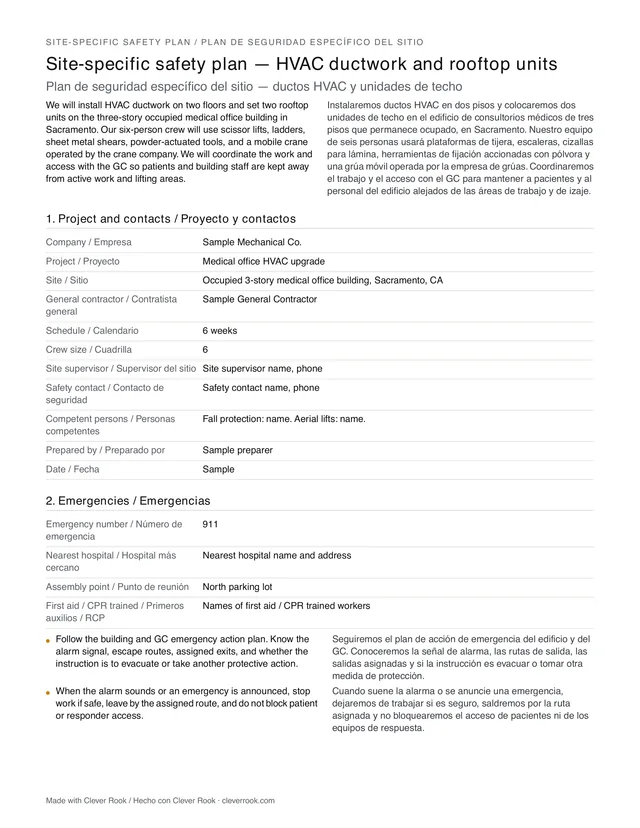
1.Project and contacts
Company, project, site, general contractor, schedule, crew size, supervisor, safety contact and competent persons.
2.Emergencies
911, the nearest hospital, the assembly point, first aid, and the steps for fire, injury and evacuation.
3.Hazards and controls
The main hazards of your scope, each with concrete controls in the order of the hierarchy of controls.
4.Safety programs
The programs that apply to the work, like fall protection, electrical, hazard communication or silica, with key points.
5.Training, PPE and site rules
What the crew needs to know and wear, and everyday practices on this site.
6.Incident reporting
Who to tell and how fast, including OSHA's 8-hour and 24-hour reporting rule.
How it stays accurate
Clever Rook matches your scope, trade and equipment to sections of the OSHA construction standards (29 CFR 1926), and every plan also draws on the rules for emergency action plans, first aid, training and serious-injury reporting. The AI writes from the official text of those sections, may only state numbers that appear in them, and lists them as sources. A plan is a draft until someone on your team reviews it.
Get a better plan
- Describe the scope like the contract does. “Install HVAC ductwork on two floors and set two rooftop units with a crane” beats “HVAC work”.
- List the equipment. Lifts, cranes, powder-actuated tools and the like each bring their own hazards and programs.
- Name the site conditions. An occupied building, a roof with a partial parapet, power lines near the lift: these change the plan.
- Check the hospital yourself. Clever Rook prints the hospital you enter; it doesn't look one up.
Questions
What is a site-specific safety plan?
A written plan, specific to one project, that says how a contractor will do its scope of work safely on that site: the hazards and how they're controlled, the safety programs that apply, training and PPE, emergency procedures and contacts, and how incidents are reported. General contractors and owners usually ask subcontractors for one before they mobilize.
Does OSHA require one?
There's no single federal OSHA rule that requires a document called a site-specific safety plan. Some OSHA standards do require written plans, such as a written exposure control plan for silica (29 CFR 1926.1153(g)), and emergency action plans where a standard calls for one (29 CFR 1926.35). Most SSSPs are required by the general contractor's or owner's contract.
Are my contacts and phone numbers sent to the AI?
No. Names, phone numbers, the hospital and the assembly point are printed in the plan exactly as you type them and never leave Clever Rook. The AI only sees the scope, trade, equipment and site conditions.
Who should review it?
Your safety contact or a competent person who knows the site, before you send it to the GC. Every plan is marked as a draft until someone reviews it and adds their name.
Sources: 29 CFR 1926.1153; 29 CFR 1926.35; 29 CFR 1904.39.
Send the GC a plan today
Free to start. About a minute from scope to PDF.