JHA / JSA generator
A job hazard analysis for your task, in English and Spanish
Describe the task, the tools and where it happens. AI drafts the steps, the hazards of each step and the controls, from the OSHA rules it cites. Your crew signs on their phones that they reviewed it.
3 free documents a month. No card needed.
- ✓ Raise the platform slowly and watch overhead clearances
- ✓ Keep both feet on the platform floor; don't climb the guardrails
- ✓ Use a drill with dust collection suited to the material
- ✓ Wear safety glasses with side shields
What you get
Steps, hazards and controls
The task in the order the crew does it, the hazards of each step, and concrete controls for each hazard.
Controls in the right order
Remove the hazard first, then guards and barriers, then work practices, then PPE, as the hierarchy of controls asks.
Before you start
The inspections, permits, training and competent-person checks the task needs.
Protective equipment
Specific PPE for the task, like safety glasses with side shields rather than just “eye protection”.
Stop-work conditions
When the crew should stop and call the supervisor.
Sign-off and record
Workers sign on their phones that they reviewed it; the PDF holds the signatures and a reviewer line.
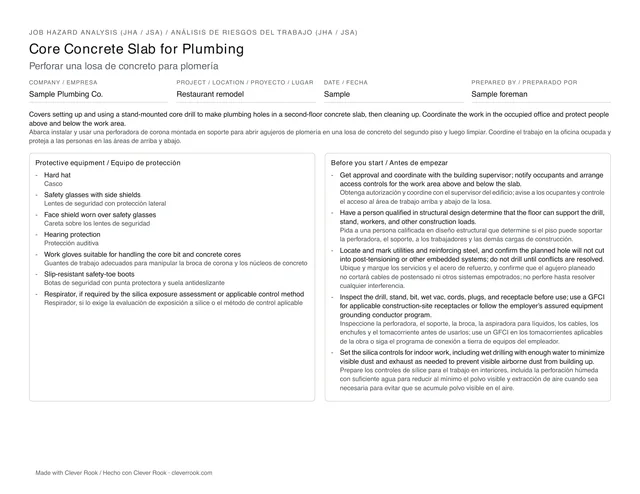
More filled-in examples, free to print: JHA examples for common construction tasks.
How it stays accurate
Clever Rook matches your task, tools and site to sections of the OSHA construction standards (29 CFR 1926), such as 1926.453 for aerial lifts or 1926.1153 for silica, and hands the AI the official text of those sections from eCFR. The JHA may only state a height, distance or limit that appears in that text, lists the sections as sources, and flags any number it can't find in them. It's a draft until a competent person on your team reviews it.
Get a better JHA
- Name the tools. “Core drill on a stand, wet vac, extension cords” gives specific hazards and controls; “drilling” doesn't.
- Say where. An occupied building, a roof edge, a warehouse with forklift traffic: the location changes the hazards.
- One task per JHA. “Set trusses with a crane” and “sheathe the roof” are two JHAs.
Questions
Is a JHA the same as a JSA?
Yes. Job hazard analysis (JHA) and job safety analysis (JSA) are two names for the same thing: a task broken into steps, with the hazards of each step and how to control them. Some general contractors and owners also call it an activity hazard analysis (AHA).
Does OSHA require a written JHA?
No general federal OSHA construction rule requires a written JHA for every task. OSHA recommends them in its guide Job Hazard Analysis (OSHA 3071), and many general contractors, owners and insurers require one before a subcontractor starts work.
How is it different from a JHA template?
A template gives you empty boxes. Clever Rook fills them in for your task, tools and site, from the OSHA sections that match, in two languages, and keeps the signed record. If you'd rather fill it in by hand, the free blank JHA template is here too.
Who should review it?
A competent person on your team who knows the site. Every JHA is marked as a draft until someone reviews it and adds their name, because no tool can see your site conditions.
Source: OSHA 3071, Job Hazard Analysis.
Your next JHA, ready before the crew is
Free to start. About a minute from task to printable JHA.