Free download · Word and PDF
Free pre-task plan template
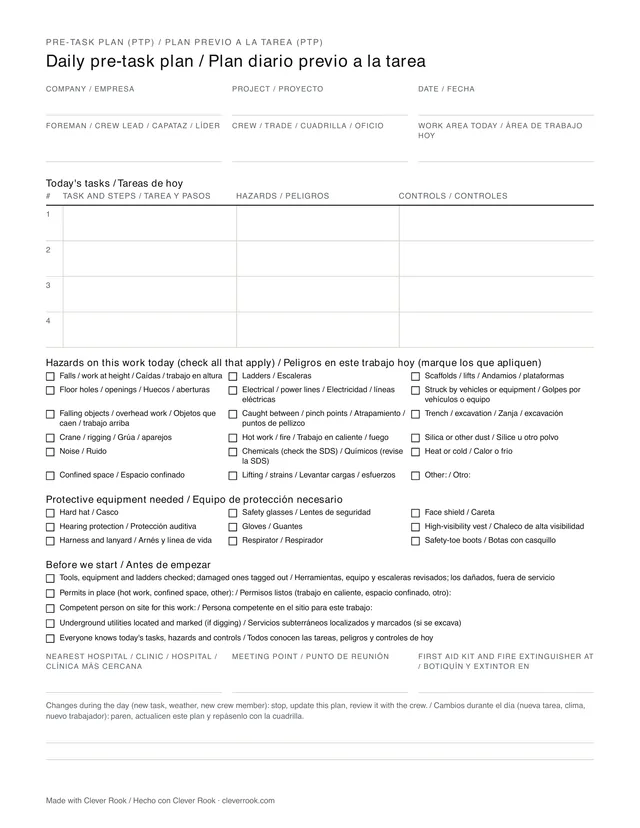
A one-page daily pre-task plan (PTP) for the start of each shift: today's tasks with their hazards and controls, checklists for hazards and protective equipment, checks before work, emergency details, and a sign-in sheet for the crew. In English, Spanish, or both on one form.
Edit it in Word: English + Español · English · Español
Letter size: the plan on page 1, the crew sign-in sheet on page 2. No sign-up needed.
What's on the form
- Company, project, date, foreman, crew and today's work area.
- Today's tasks: each task and its steps, hazards and controls.
- A hazard checklist: falls, ladders, scaffolds and lifts, openings, electrical, struck-by, falling objects, caught-between, trenches, cranes, hot work, silica and dust, noise, chemicals, heat or cold, confined spaces and lifting.
- Protective equipment the work needs today.
- Before we start: tools and equipment checked, permits, the competent person for the work, utilities located before digging, and everyone briefed.
- Emergency details: nearest hospital or clinic, meeting point, first aid kit and fire extinguisher.
- Changes and notes for when the work changes during the day, and a sign-in sheet.
How to run a pre-task plan at the start of the shift
- Walk the work area first. Look at what changed since yesterday: weather, other trades, open holes, new equipment.
- Write today's tasks and, for each one, the main hazards and how the crew will control them. If the task has a JHA, take the controls from it.
- Go down the checklists with the crew. Tick each hazard that applies and the equipment the work needs.
- Confirm the checks: inspections done, permits in hand, the competent person named, utilities marked.
- Agree on the emergency details, so everyone knows where to go and who calls for help.
- Have everyone sign before work starts, including anyone who joins later in the day.
OSHA's Recommended Practices for Safety and Health Programs in Construction suggest “daily planning meetings, huddles, toolbox talks, or tailgate meetings to engage workers in the safety and health program.” A pre-task plan is the planning meeting written down.
When to update it during the day
Stop and update the plan when a new task starts, conditions change (rain, wind, another trade working overhead), a new person joins the crew, or something goes wrong. Write the change in the notes box and go over it with the crew.
Pre-task plan, JHA or toolbox talk?
A JHA or JSA plans one task in detail and is reused; the pre-task plan covers one day. A toolbox talk teaches one safety topic. See JSA vs JHA for a side-by-side comparison.
Questions
What is a pre-task plan?
A short plan a crew fills in at the start of the shift for that day's work: the tasks, their hazards and controls, the protective equipment, permits and inspections, and what to do in an emergency. The crew reviews it together and signs it.
Does OSHA require a pre-task plan?
Federal OSHA doesn't require a form by that name. It requires employers to instruct each employee in recognizing and avoiding unsafe conditions (29 CFR 1926.21(b)(2)), and its recommended practices for construction suggest daily planning meetings and huddles. Many general contractors require a daily pre-task plan from every crew on their sites.
How is it different from a JHA or JSA?
A JHA or JSA plans one task in detail and is reused each time the crew does that task. A pre-task plan covers one crew's whole day and is filled in fresh every shift. A crew can use the JHA as the source for the day's controls.
What if the work changes during the day?
Stop, update the plan with the new task or condition, and go over the change with the crew. The form has a box for changes and notes.
Is there a Spanish version?
Yes. Download it in Spanish only, or with English and Spanish on the same form, as a PDF or a Word file.
Sources: OSHA 3886, Recommended Practices for Safety and Health Programs in Construction; 29 CFR 1926.21.