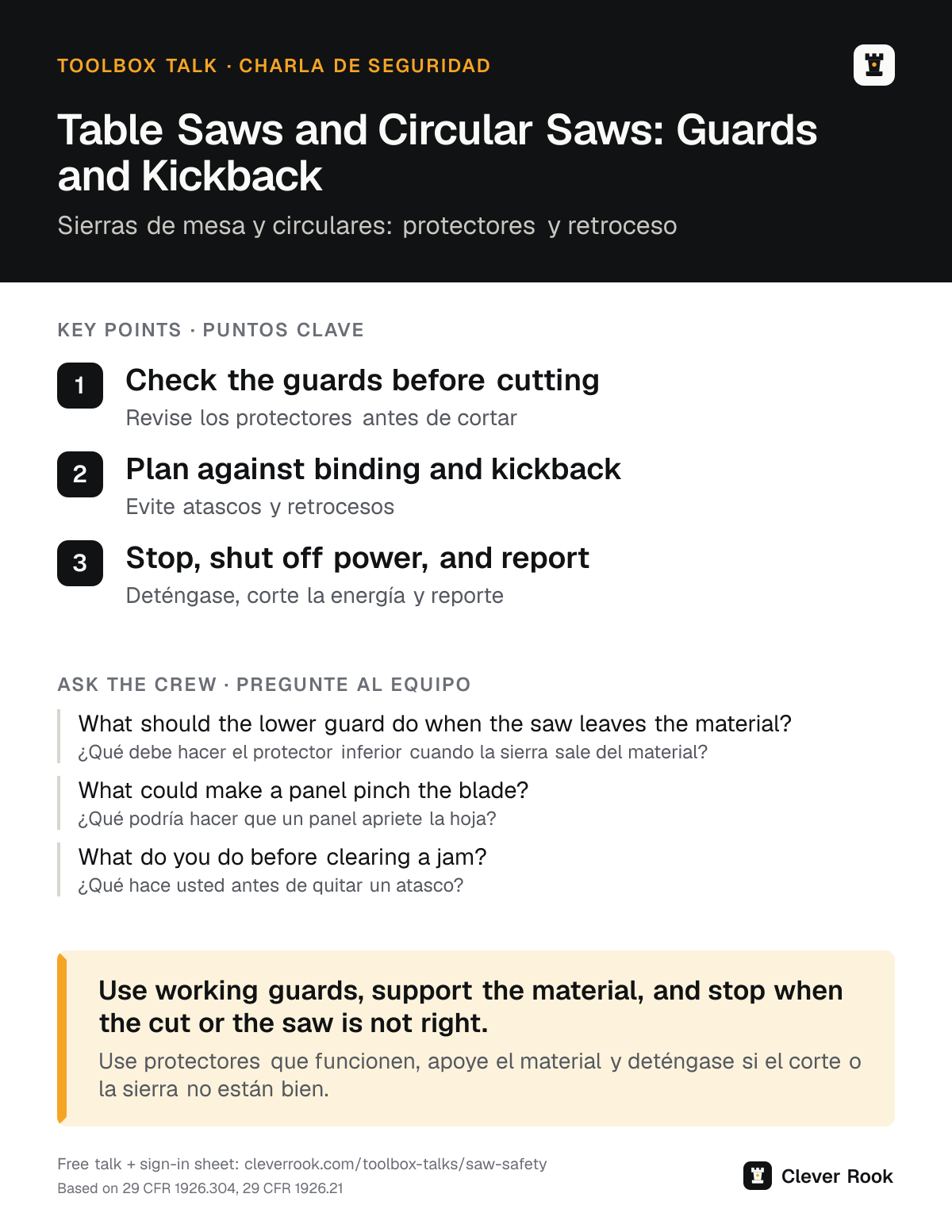
Table Saws and Circular Saws: Guards and Kickback
Sierras de mesa y circulares: protectores y retroceso
Cutting lumber and plywood puts your hands near moving teeth. The saw can also throw material back at you. A working guard helps protect you, but it does not replace a planned cut. Before you start, make sure the guard works and the material can move through the cut without binding.
Cortar madera y triplay pone sus manos cerca de dientes en movimiento. La sierra también puede lanzarle material de regreso. Un protector que funciona le ayuda a protegerse, pero no reemplaza un corte planeado. Antes de empezar, asegúrese de que el protector funcione y de que el material pueda pasar por el corte sin atascarse.
Check the guards before cutting
Revise los protectores antes de cortar
OSHA requires portable circular saws to have guards above and below the shoe. The shoe is the flat base that rides on the material. Check for missing, damaged, or loose parts before use.
OSHA exige que las sierras circulares portátiles tengan protectores arriba y abajo de la zapata. La zapata es la base plana que se apoya sobre el material. Revise si faltan piezas o si están dañadas o flojas antes de usarla.
The lower guard must return to cover the blade automatically and instantly when the saw leaves the material. If it sticks or stays open, stop and report it. Do not tie or wedge it open.
El protector inferior debe regresar a cubrir la hoja automáticamente y al instante cuando la sierra sale del material. Si se atora o se queda abierto, deténgase y repórtelo. No lo amarre ni lo trabe abierto.
On a hand-fed table saw, a hood must cover the blade above the table and above the material. It must adjust to the material's thickness and stay in contact with it, without making the material hard to push through.
En una sierra de mesa que se alimenta a mano, una cubierta debe tapar la hoja sobre la mesa y sobre el material. Debe ajustarse al grosor del material y mantenerse en contacto con él, sin dificultar que el material pase.
Check that the table saw hood is mounted solid and lined up with the blade. A loose, damaged, or crooked hood is a reason to stop, not something to work around.
Revise que la cubierta de la sierra de mesa esté bien montada y alineada con la hoja. Una cubierta floja, dañada o torcida es motivo para detenerse, no para improvisar y seguir trabajando.
Plan against binding and kickback
Evite atascos y retrocesos
Kickback is when the saw or the material is suddenly thrown back toward you. Binding, where the cut closes and pinches the blade, can start it. Don't force a cut that is fighting you.
El retroceso es cuando la sierra o el material sale lanzado de repente hacia usted. Puede empezar cuando el corte se cierra y aprieta la hoja, lo que se llama atasco. No fuerce un corte que le ofrece resistencia.
Before cutting plywood or other panels, set up solid support for the panel and the cut pieces. Plan where each piece will go so its weight does not twist the material against the blade.
Antes de cortar triplay u otros paneles, prepare apoyos firmes para el panel y para las piezas cortadas. Planee hacia dónde irá cada pieza para que su peso no tuerza el material contra la hoja.
Keep your hands out of the blade's path. Plan how you will feed the cut, and any help you need, before you start. Don't reach across a moving blade to catch or pull a piece.
Mantenga las manos fuera del camino de la hoja. Antes de empezar, planee cómo va a pasar el material y qué ayuda necesita. No pase las manos sobre una hoja en movimiento para agarrar o jalar una pieza.
If the material binds or shifts, stop the cut and let the blade stop before you fix the setup. Don't keep pushing just to finish the last part.
Si el material se atasca o se mueve, detenga el corte y deje que la hoja pare antes de corregir el acomodo. No siga empujando solo para terminar lo que falta.
Stop, shut off power, and report
Deténgase, corte la energía y reporte
OSHA requires fixed power woodworking tools, like a stationary table saw, to have a disconnect switch that can be locked or tagged in the off position. Know where it is before you use the saw.
OSHA exige que las máquinas fijas eléctricas para madera, como una sierra de mesa fija, tengan un interruptor de desconexión que se pueda bloquear o etiquetar en la posición de apagado. Ubíquelo antes de usar la sierra.
Before clearing a jam or working on a guard, unplug the saw. On a fixed saw, lock or tag the disconnect switch off. A stopped blade alone does not prevent an unexpected restart.
Antes de quitar un atasco o trabajar en un protector, desconecte la sierra. En una sierra fija, bloquee o etiquete el interruptor de desconexión en apagado. Que la hoja esté parada no evita por sí solo un arranque inesperado.
OSHA requires your employer to teach you how to recognize and avoid unsafe conditions in your work. If you have not been trained on the saw or the cut, ask your supervisor before you start.
OSHA exige que su empleador le enseñe a reconocer y evitar condiciones peligrosas en su trabajo. Si no lo han capacitado para esa sierra o ese corte, pregunte a su supervisor antes de empezar.
What would you do? · ¿Qué haría usted?
A circular saw's lower guard stays open after a panel cut. Someone suggests finishing the pile first. What would you do before another cut?
El protector inferior de una sierra circular se queda abierto después de cortar un panel. Alguien propone terminar primero la pila. ¿Qué haría usted antes de hacer otro corte?
Questions for the crew · Preguntas para el equipo
- 1
What should the lower guard do when the saw leaves the material?
¿Qué debe hacer el protector inferior cuando la sierra sale del material?
- 2
What could make a panel pinch the blade?
¿Qué podría hacer que un panel apriete la hoja?
- 3
What do you do before clearing a jam?
¿Qué hace usted antes de quitar un atasco?
Use working guards, support the material, and stop when the cut or the saw is not right.
Use protectores que funcionen, apoye el material y deténgase si el corte o la sierra no están bien.